3 books on Brain-computer interface [PDF]
Like
23
Books on brain-computer interfaces (BCIs) provide a deep understanding of neuroscience and technical components underpinning BCIs, including neural signal processing, neurofeedback and hardware integration.
1. Neural Network Technologies and Brain-Computer Interfaces
2025 by Al Ansari, Mohammed Saleh, Joshi, Kapil
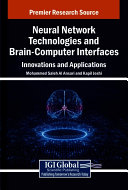
The book is a set of whitepapers from Indian specialists describing specific BCI studies. All of them are based on the use of EEG technology. This is, of course, the simplest, cheapest and safest method for humans (an external cap with electrodes is much simpler than the invasive installation of an electrode matrix directly into the gray matter). But, of course, with the help of EEG we can only get general information about the brain's state rather than specific intents of actions or, even more so, words. However, machine learning technologies allow us to squeeze the maximum out of EEG patterns. Several hours of training the neural network on one person allows to quite accurately determine the intent of movement of a certain hand or leg, as well as a command for the cursor on the screen to move in a certain direction. Even more interesting is the possibility of transferring knowledge (or better to say neural network structure) between different people and accumulating a single dataset for training a universal neural network decoding the EEG signals coming from the cap.
Download PDF
2. Brain–Computer Interface Research: A State-of-the-Art Summary
2020 by Christoph Guger, Brendan Z. Allison, Kai Miller
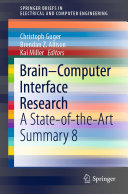
This book is a collection of real-world BCI application studies in medicine and scientific research. I especially liked the case of creating an electromyographic (EMG) interface for reading/recognition handwritten language. After all, this is a great idea: while Elon Musk and other are trying to insert neural implants directly into the brain (which is dangerous and unreliable, in terms of correct signal recognition), you can install sensors that detect micromovements or even muscle tensions in the hand and forearm so that they can read handwritten text patterns. Of course, the speed of language digitization will not be as high as when recognizing brain electrical impulses (or monitoring the tension of the vocal cords), but we can create a fully non-invasive technology that will reliably read human speech. Such a neural interface can be used both in medicine and in consumer applications. Imagine that you ride a subway and communicate with your virtual assistant with finger movements, unnoticed by others. The book describes a real experiment in creating such a neural interface. The researchers transformed the EMG signals into continuous handwriting patterns and discretely decoded character fonts. For this purpose, they used Wiener and Kalman filters, as well as machine learning algorithms. They also suggest that handwriting can be decoded from cortical activity, for example from signals recorded by electrocorticography (ECOG).
Download PDF
3. Brain-Computer Interfacing
2013 by Rajesh P. N. Rao
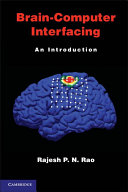
This book covers the basics of building BCIs, both invasive and non-invasive, but (according to the author) the most important advances have been made using invasive methods. Invasive methods use implanted electode arrays to record the activity of individual neurons or populations of neurons in the brain. Experiments have been conducted primarily on animals using operant conditioning (an animal is rewarded for performing an action if it selectively activates a neuron or population of neurons to move a cursor or prosthetic device in the appropriate manner). In the late 1960s, in one of the first examples of a brain-computer interface, Eberhard Fetz at the University of Washington used the idea of operant conditioning to show that the activity of a single neuron in the motor cortex of a primate could be conditioned to control the needle of an analog meter. The movement of the needle was directly related to the firing rate of the neuron: when the needle crossed a threshold, the monkey received a reward. After several training sessions, the monkey learned to consistently move the needle past the threshold, increasing the firing rate of the recorded neuron. Operant conditioning remains an important technique for brain-computer interfaces because it does not require complex machine learning algorithms and relies on the brain’s remarkable ability to adapt. However, a potential drawback of this method is that the learning time to achieve control of complex devices can be significant. This has spurred the development of “co-adaptive” BCIs, in which both the brain and the BCI system adapt to speed up the learning process.
Download PDF
How to download PDF:
1. Install Gooreader
2. Enter Book ID to the search box and press Enter
3. Click "Download Book" icon and select PDF*
* - note that for yellow books only preview pages are downloaded
1. Neural Network Technologies and Brain-Computer Interfaces
2025 by Al Ansari, Mohammed Saleh, Joshi, Kapil
The book is a set of whitepapers from Indian specialists describing specific BCI studies. All of them are based on the use of EEG technology. This is, of course, the simplest, cheapest and safest method for humans (an external cap with electrodes is much simpler than the invasive installation of an electrode matrix directly into the gray matter). But, of course, with the help of EEG we can only get general information about the brain's state rather than specific intents of actions or, even more so, words. However, machine learning technologies allow us to squeeze the maximum out of EEG patterns. Several hours of training the neural network on one person allows to quite accurately determine the intent of movement of a certain hand or leg, as well as a command for the cursor on the screen to move in a certain direction. Even more interesting is the possibility of transferring knowledge (or better to say neural network structure) between different people and accumulating a single dataset for training a universal neural network decoding the EEG signals coming from the cap.
Download PDF
2. Brain–Computer Interface Research: A State-of-the-Art Summary
2020 by Christoph Guger, Brendan Z. Allison, Kai Miller
This book is a collection of real-world BCI application studies in medicine and scientific research. I especially liked the case of creating an electromyographic (EMG) interface for reading/recognition handwritten language. After all, this is a great idea: while Elon Musk and other are trying to insert neural implants directly into the brain (which is dangerous and unreliable, in terms of correct signal recognition), you can install sensors that detect micromovements or even muscle tensions in the hand and forearm so that they can read handwritten text patterns. Of course, the speed of language digitization will not be as high as when recognizing brain electrical impulses (or monitoring the tension of the vocal cords), but we can create a fully non-invasive technology that will reliably read human speech. Such a neural interface can be used both in medicine and in consumer applications. Imagine that you ride a subway and communicate with your virtual assistant with finger movements, unnoticed by others. The book describes a real experiment in creating such a neural interface. The researchers transformed the EMG signals into continuous handwriting patterns and discretely decoded character fonts. For this purpose, they used Wiener and Kalman filters, as well as machine learning algorithms. They also suggest that handwriting can be decoded from cortical activity, for example from signals recorded by electrocorticography (ECOG).
Download PDF
3. Brain-Computer Interfacing
2013 by Rajesh P. N. Rao
This book covers the basics of building BCIs, both invasive and non-invasive, but (according to the author) the most important advances have been made using invasive methods. Invasive methods use implanted electode arrays to record the activity of individual neurons or populations of neurons in the brain. Experiments have been conducted primarily on animals using operant conditioning (an animal is rewarded for performing an action if it selectively activates a neuron or population of neurons to move a cursor or prosthetic device in the appropriate manner). In the late 1960s, in one of the first examples of a brain-computer interface, Eberhard Fetz at the University of Washington used the idea of operant conditioning to show that the activity of a single neuron in the motor cortex of a primate could be conditioned to control the needle of an analog meter. The movement of the needle was directly related to the firing rate of the neuron: when the needle crossed a threshold, the monkey received a reward. After several training sessions, the monkey learned to consistently move the needle past the threshold, increasing the firing rate of the recorded neuron. Operant conditioning remains an important technique for brain-computer interfaces because it does not require complex machine learning algorithms and relies on the brain’s remarkable ability to adapt. However, a potential drawback of this method is that the learning time to achieve control of complex devices can be significant. This has spurred the development of “co-adaptive” BCIs, in which both the brain and the BCI system adapt to speed up the learning process.
Download PDF
How to download PDF:
1. Install Gooreader
2. Enter Book ID to the search box and press Enter
3. Click "Download Book" icon and select PDF*
* - note that for yellow books only preview pages are downloaded