3 books on AI for Medicine [PDF]
Like
26
These books are covering the applications of artificial intelligence in healthcare: imaging analysis, drug discovery, predictive analytics and patient care optimization.
1. INTEGRATING GENERATIVE AI IN MEDICAL PRACTICE: Enhancing Patient Care & Diagnostics With Agentic AI Systems
2025 by Zoey Sorensen, Marc Stanford
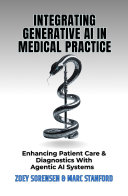
This is a book about the use of language generative models in medical practice. These models are mainly used for automated creation of medical documentation, filling in patient data, communicating with patients via chatbots. But the most interesting part is the use of LLM to support decision-making by doctors. That is, if you carefully fill out a patient's medical record and current disease history and ask the AI what diagnosis and treatment tactics it suggests, then the AI (which has read all the medical books in the world and millions of real cases) will provide a logical solution. However, you need to understand that the AI does not seek to cure this particular patient, it only seeks to be as logical as possible (within the boundaries of the logic that has formed in its neural network). Therefore, its answer may be logical, but not optimal (or even useless/harmful) in this particular case. Therefore, of course, the doctor must pass the AI's proposal through her own neural network in the brain (which contains additional visual data about the patient and the doctor's intuition) and correct AI's proposal.
Download PDF
2. AI in Clinical Medicine: A Practical Guide for Healthcare Professionals
2023 by Michael F. Byrne, Nasim Parsa, Alexandra T. Greenhill, Daljeet Chahal, Omer Ahmad, Ulas Bagci
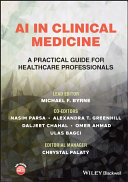
This book is a collection of various articles about the use of AI in clinical medicine. It also contains a chapter about the history of AI in medicine. I found it interesting to read about the expert systems because they are still used due to the hallucinations and inexplicability of language models. They appeared in 1970 as computer programs that can help a doctor make decisions. To create such a system, you need a human expert, from whom knowledge is transferred to a knowledge base and an interface for interacting with this base. Most expert systems used in clinical applications were rule-based. For example, a simple rule for a blood pressure (BP) monitoring system could be the following: if systolic BP is below 120 mmHg, the condition is considered normal; if above 140 - hypertension. Well-known examples of expert systems are MYCIN (designed to help clinicians diagnose and select treatments for bacterial infections) and CADUCEUS (developed in the early 1980s, an extension of MYCIN and used to diagnose a wider range of diseases). The advantage of expert systems is that they are explainable and therefore more trustworthy than popular deep neural networks. So, the author concludes that AI will become more widespread in clinical medicine, if it manage to combine intelligence of neural networks and interpretability of expert systems.
Download PDF
3. Recent Advances in AI-enabled Automated Medical Diagnosis
2022 by Richard Jiang, Li Zhang, Hua-Liang Wei, Danny Crookes, Paul Chazot
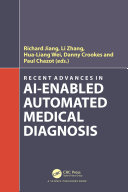
This book contains a set of scientific papers on AI diagnostics and about half of them concern the currently popular topic of COVID-19. In particular, there is a detailed description of the creation of the CoviNet Enhanced model for diagnosing COVID from CT images. It was implemented in Jupyter-notebook using the Python libraries Tensorflow and Keras. Data preprocessing was performed using the Nibabel library for medical images, which can read tomographic data in the .nii format. The model was trained and evaluated on the UCSD-AI4H and MosMed lung CT datasets. The developers claim that the ML model demonstrates not only high sensitivity, but also high specificity. High performance is achieved through the use of both deep 3D convolutional neural network and texture feature detection using the Leung-Malik method with support vector machines (SVM). In cases when 3D CNN is not confident in its prediction, texture features using SVM help to complement 3D CNN. This hybrid deep learning approach with texture detection and conditional voting helps to overcome the weaknesses of 3D CNN itself. Experimental results show that the proposed method is very effective in detecting COVID-19.
Download PDF
How to download PDF:
1. Install Gooreader
2. Enter Book ID to the search box and press Enter
3. Click "Download Book" icon and select PDF*
* - note that for yellow books only preview pages are downloaded
1. INTEGRATING GENERATIVE AI IN MEDICAL PRACTICE: Enhancing Patient Care & Diagnostics With Agentic AI Systems
2025 by Zoey Sorensen, Marc Stanford
This is a book about the use of language generative models in medical practice. These models are mainly used for automated creation of medical documentation, filling in patient data, communicating with patients via chatbots. But the most interesting part is the use of LLM to support decision-making by doctors. That is, if you carefully fill out a patient's medical record and current disease history and ask the AI what diagnosis and treatment tactics it suggests, then the AI (which has read all the medical books in the world and millions of real cases) will provide a logical solution. However, you need to understand that the AI does not seek to cure this particular patient, it only seeks to be as logical as possible (within the boundaries of the logic that has formed in its neural network). Therefore, its answer may be logical, but not optimal (or even useless/harmful) in this particular case. Therefore, of course, the doctor must pass the AI's proposal through her own neural network in the brain (which contains additional visual data about the patient and the doctor's intuition) and correct AI's proposal.
Download PDF
2. AI in Clinical Medicine: A Practical Guide for Healthcare Professionals
2023 by Michael F. Byrne, Nasim Parsa, Alexandra T. Greenhill, Daljeet Chahal, Omer Ahmad, Ulas Bagci
This book is a collection of various articles about the use of AI in clinical medicine. It also contains a chapter about the history of AI in medicine. I found it interesting to read about the expert systems because they are still used due to the hallucinations and inexplicability of language models. They appeared in 1970 as computer programs that can help a doctor make decisions. To create such a system, you need a human expert, from whom knowledge is transferred to a knowledge base and an interface for interacting with this base. Most expert systems used in clinical applications were rule-based. For example, a simple rule for a blood pressure (BP) monitoring system could be the following: if systolic BP is below 120 mmHg, the condition is considered normal; if above 140 - hypertension. Well-known examples of expert systems are MYCIN (designed to help clinicians diagnose and select treatments for bacterial infections) and CADUCEUS (developed in the early 1980s, an extension of MYCIN and used to diagnose a wider range of diseases). The advantage of expert systems is that they are explainable and therefore more trustworthy than popular deep neural networks. So, the author concludes that AI will become more widespread in clinical medicine, if it manage to combine intelligence of neural networks and interpretability of expert systems.
Download PDF
3. Recent Advances in AI-enabled Automated Medical Diagnosis
2022 by Richard Jiang, Li Zhang, Hua-Liang Wei, Danny Crookes, Paul Chazot
This book contains a set of scientific papers on AI diagnostics and about half of them concern the currently popular topic of COVID-19. In particular, there is a detailed description of the creation of the CoviNet Enhanced model for diagnosing COVID from CT images. It was implemented in Jupyter-notebook using the Python libraries Tensorflow and Keras. Data preprocessing was performed using the Nibabel library for medical images, which can read tomographic data in the .nii format. The model was trained and evaluated on the UCSD-AI4H and MosMed lung CT datasets. The developers claim that the ML model demonstrates not only high sensitivity, but also high specificity. High performance is achieved through the use of both deep 3D convolutional neural network and texture feature detection using the Leung-Malik method with support vector machines (SVM). In cases when 3D CNN is not confident in its prediction, texture features using SVM help to complement 3D CNN. This hybrid deep learning approach with texture detection and conditional voting helps to overcome the weaknesses of 3D CNN itself. Experimental results show that the proposed method is very effective in detecting COVID-19.
Download PDF
How to download PDF:
1. Install Gooreader
2. Enter Book ID to the search box and press Enter
3. Click "Download Book" icon and select PDF*
* - note that for yellow books only preview pages are downloaded