4 books on Quantum Computing [PDF]
Like
16
Quantum computer (unlike conventional computers) instead of bits (0,1) use qubits, that can be both 0 and 1 simultaneously. Single qubit can store a superposition of two states at once. A group of 4 qubits can solve a task that only 16 bits can solve. Moreover, while a conventional computer tries bit combinations sequentially, quantum computer tries all combinations simultaneously. Imagine forgetting the password to your safe. Conventional PC would try every combination of numbers one by one until it finds the correct one. Quantum computer, however, could "check" everything at once and instantly return the correct code.
In reality, of course, things aren't quite so simple. For every such task - special quantum algorithm should be developed. But such algorithms already exist for a number of tasks. For example, there's a quantum search algorithm that can find the right number among a trillion possible combinations in literally seconds (while it would take a conventional computer weeks to try them). It turns out that for some tasks, quantum computer can deliver not just a performance boost, but a whole new level of performance.
It's important to understand that a quantum computer isn't faster at everything (you can't play Dota on one). If you ask a quantum machine and a conventional PC to add two numbers, they'll perform equally. The power of quantum computers manifests itself in special tasks that require trying an incredibly large number of options or simulating complex physical systems.
But how do qubits manage to be in multiple states simultaneously? They are implemented using atoms or electrons. At such a microscopic level, nature behaves in ways that are unusual to our common sense. In particular, Superposition happens. This is when an object exists in all possible states simultaneously. You may have heard of the thought experiment with Schrödinger's cat, which is simultaneously alive and dead as long as the box is closed. Of course, in reality, no one tortures cats, but quantum particles really can be "two in one." Imagine a coin. If you toss it in the air, while it's spinning, it appears to you to be both heads and tails. You can't know which way it will land until it lands in your palm. In the world of qubits, a "spinning coin" is the normal state. A qubit can be both heads and tails at once. But as soon as we measure it - the superposition disappears - the coin lands on the concrete side.
Here are some PDF books about Quantum Computing:
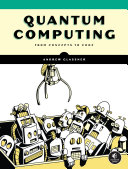
1. Quantum Computing: From Concepts to Code
2025 by Andrew Glassner
Download PDF
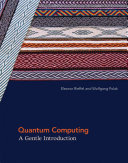
2. Quantum Computing: A Gentle Introduction
2014 by Eleanor G. Rieffel, Wolfgang H. Polak
Download PDF
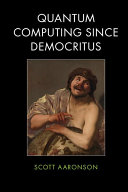
3. Quantum Computing Since Democritus
2013 by Scott Aaronson
Download PDF
4. Quantum Computing Explained
2007 by David McMahon
Download PDF
How to download PDF:
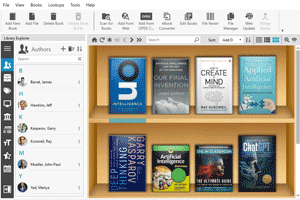
1. Install Gooreader
2. Enter Book ID to the search box and press Enter
3. Click "Download Book" icon and select PDF*
* - note that for yellow books only preview pages are downloaded
In reality, of course, things aren't quite so simple. For every such task - special quantum algorithm should be developed. But such algorithms already exist for a number of tasks. For example, there's a quantum search algorithm that can find the right number among a trillion possible combinations in literally seconds (while it would take a conventional computer weeks to try them). It turns out that for some tasks, quantum computer can deliver not just a performance boost, but a whole new level of performance.
It's important to understand that a quantum computer isn't faster at everything (you can't play Dota on one). If you ask a quantum machine and a conventional PC to add two numbers, they'll perform equally. The power of quantum computers manifests itself in special tasks that require trying an incredibly large number of options or simulating complex physical systems.
But how do qubits manage to be in multiple states simultaneously? They are implemented using atoms or electrons. At such a microscopic level, nature behaves in ways that are unusual to our common sense. In particular, Superposition happens. This is when an object exists in all possible states simultaneously. You may have heard of the thought experiment with Schrödinger's cat, which is simultaneously alive and dead as long as the box is closed. Of course, in reality, no one tortures cats, but quantum particles really can be "two in one." Imagine a coin. If you toss it in the air, while it's spinning, it appears to you to be both heads and tails. You can't know which way it will land until it lands in your palm. In the world of qubits, a "spinning coin" is the normal state. A qubit can be both heads and tails at once. But as soon as we measure it - the superposition disappears - the coin lands on the concrete side.
Here are some PDF books about Quantum Computing:
1. Quantum Computing: From Concepts to Code
2025 by Andrew Glassner
Download PDF
2. Quantum Computing: A Gentle Introduction
2014 by Eleanor G. Rieffel, Wolfgang H. Polak
Download PDF
3. Quantum Computing Since Democritus
2013 by Scott Aaronson
Download PDF
4. Quantum Computing Explained
2007 by David McMahon
Download PDF
How to download PDF:
1. Install Gooreader
2. Enter Book ID to the search box and press Enter
3. Click "Download Book" icon and select PDF*
* - note that for yellow books only preview pages are downloaded