3 books on AI for Software development [PDF]
Like
20
These books explore automated code generation, AI-based bug detection, code optimization and other AI-based software development tools.
1. Generative AI in Software Engineering
2025 by Aguilar-Calderón, José Alfonso
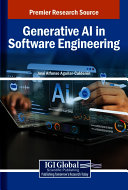
The authors of this book have noticed, perhaps, the main problem of using AI to generate program code - the lack of intent. After all, language models almost always generate correct code. In 5-10% of cases, it contains errors, but by inserting the exception message back into the IDE chat, you can fix these errors quite quickly. The lack of context is also not a problem any more. You can add the necessary files with code or documentation to the chat context. And basing on all this context, AI can generate correct code, but solve your problem incorrectly in many ways. It's all about the lack of intent. I can be said that the intent of a generative model is only to remain as logical as possible, so that no one can accuse it of its code being illogical. While a human programmer, performing the same task, will make decisions based on his intent to create a program that works and for which money will be paid. Therefore, he may use crutches somewhere, make illogical code, but in general, his program will meet the customer’s expectations.
Download PDF
2. Advancing Software Engineering Through AI, Federated Learning, and Large Language Models
2024 by Sharma, Avinash Kumar, Chanderwal, Nitin, Prajapati, Amarjeet, Singh, Pancham, Kansal, Mrignainy
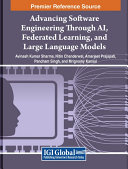
This book is a collection of mostly theoretical studies on the application of artificial intelligence, machine learning, federated learning and large language models (like GPT-3) in the field of software engineering. The study provides historical context for the evolution of these technologies, highlighting key milestones. The key finding is that AI significantly accelerates software development and deployment cycles. By locally training models on individual devices and centrally aggregating their resulting data, federated learning optimizes developer interactions and decision-making. This not only makes the development environment and team more agile, but also reduces the latency in the feedback loop, allowing for faster response to changing requirements. The author says that the ability to accelerate development cycles is critical in today's rapidly changing technological world, where success is often determined by the speed of innovation.
Download PDF
3. Optimising the Software Development Process with Artificial Intelligence
2023 by José Raúl Romero, Inmaculada Medina-Bulo, Francisco Chicano
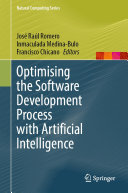
This book explores how artificial intelligence techniques can support project managers in two key PM activities: project schedule planning and resource estimation. The authors note that software project management is very complicated task that involves interactions between multiple stakeholders and implementers with conflicting goals. In such circumstances, AI can play a significant role by helping PMs make more informed management decisions. First, that authors present two case studies of project requirements extraction and prioritization based on user feedback. Next - solutions to these two problems based on AI techniques, in particular machine learning, natural language processing and genetic algorithms, are considered. Based on the two case studies, the authors also briefly touch upon current trends in requirements management. Finally, the limitations of artificial intelligence techniques are discussed, as well as prospects for their application in other requirements engineering activities.
Download PDF
How to download PDF:
1. Install Gooreader
2. Enter Book ID to the search box and press Enter
3. Click "Download Book" icon and select PDF*
* - note that for yellow books only preview pages are downloaded
1. Generative AI in Software Engineering
2025 by Aguilar-Calderón, José Alfonso
The authors of this book have noticed, perhaps, the main problem of using AI to generate program code - the lack of intent. After all, language models almost always generate correct code. In 5-10% of cases, it contains errors, but by inserting the exception message back into the IDE chat, you can fix these errors quite quickly. The lack of context is also not a problem any more. You can add the necessary files with code or documentation to the chat context. And basing on all this context, AI can generate correct code, but solve your problem incorrectly in many ways. It's all about the lack of intent. I can be said that the intent of a generative model is only to remain as logical as possible, so that no one can accuse it of its code being illogical. While a human programmer, performing the same task, will make decisions based on his intent to create a program that works and for which money will be paid. Therefore, he may use crutches somewhere, make illogical code, but in general, his program will meet the customer’s expectations.
Download PDF
2. Advancing Software Engineering Through AI, Federated Learning, and Large Language Models
2024 by Sharma, Avinash Kumar, Chanderwal, Nitin, Prajapati, Amarjeet, Singh, Pancham, Kansal, Mrignainy
This book is a collection of mostly theoretical studies on the application of artificial intelligence, machine learning, federated learning and large language models (like GPT-3) in the field of software engineering. The study provides historical context for the evolution of these technologies, highlighting key milestones. The key finding is that AI significantly accelerates software development and deployment cycles. By locally training models on individual devices and centrally aggregating their resulting data, federated learning optimizes developer interactions and decision-making. This not only makes the development environment and team more agile, but also reduces the latency in the feedback loop, allowing for faster response to changing requirements. The author says that the ability to accelerate development cycles is critical in today's rapidly changing technological world, where success is often determined by the speed of innovation.
Download PDF
3. Optimising the Software Development Process with Artificial Intelligence
2023 by José Raúl Romero, Inmaculada Medina-Bulo, Francisco Chicano
This book explores how artificial intelligence techniques can support project managers in two key PM activities: project schedule planning and resource estimation. The authors note that software project management is very complicated task that involves interactions between multiple stakeholders and implementers with conflicting goals. In such circumstances, AI can play a significant role by helping PMs make more informed management decisions. First, that authors present two case studies of project requirements extraction and prioritization based on user feedback. Next - solutions to these two problems based on AI techniques, in particular machine learning, natural language processing and genetic algorithms, are considered. Based on the two case studies, the authors also briefly touch upon current trends in requirements management. Finally, the limitations of artificial intelligence techniques are discussed, as well as prospects for their application in other requirements engineering activities.
Download PDF
How to download PDF:
1. Install Gooreader
2. Enter Book ID to the search box and press Enter
3. Click "Download Book" icon and select PDF*
* - note that for yellow books only preview pages are downloaded